Best Counties for Land Investing in Georgia
A data-backed guide for 2026 covering Atlanta spillover, the coastal plain, and Blue Ridge foothills.
Georgia's land market operates under the gravitational pull of Atlanta — the state's economic engine, population center, and the source of most of the demand radiating outward into surrounding counties. But meaningful opportunity exists well beyond the metro, from the southern coastal plain to the northern Blue Ridge foothills.
The fundamentals are strong. Georgia has maintained consistent population growth, with the Atlanta MSA adding roughly 75,000 residents in the most recent year. Property taxes are relatively low. The state has a strong property rights framework and diverse geography spanning from the barrier islands to the Appalachian foothills. And for data-driven investors, Georgia benefits from one of the better centralized property data platforms in the Southeast.
With 159 counties — second only to Texas — Georgia creates an enormous but navigable market for investors willing to do the county-level homework.
The key is knowing which counties offer the right mix of volume, margins, and data quality, and understanding the state-specific verification factors that can make or break a deal.
How We Evaluate Counties
Same framework as our other state guides: transaction volume, margin potential, data accessibility, verification complexity, competition level. Georgia adds three state-specific considerations that demand attention. For county-level analysis in other states, see our guides for Florida, Texas, North Carolina, and Tennessee.
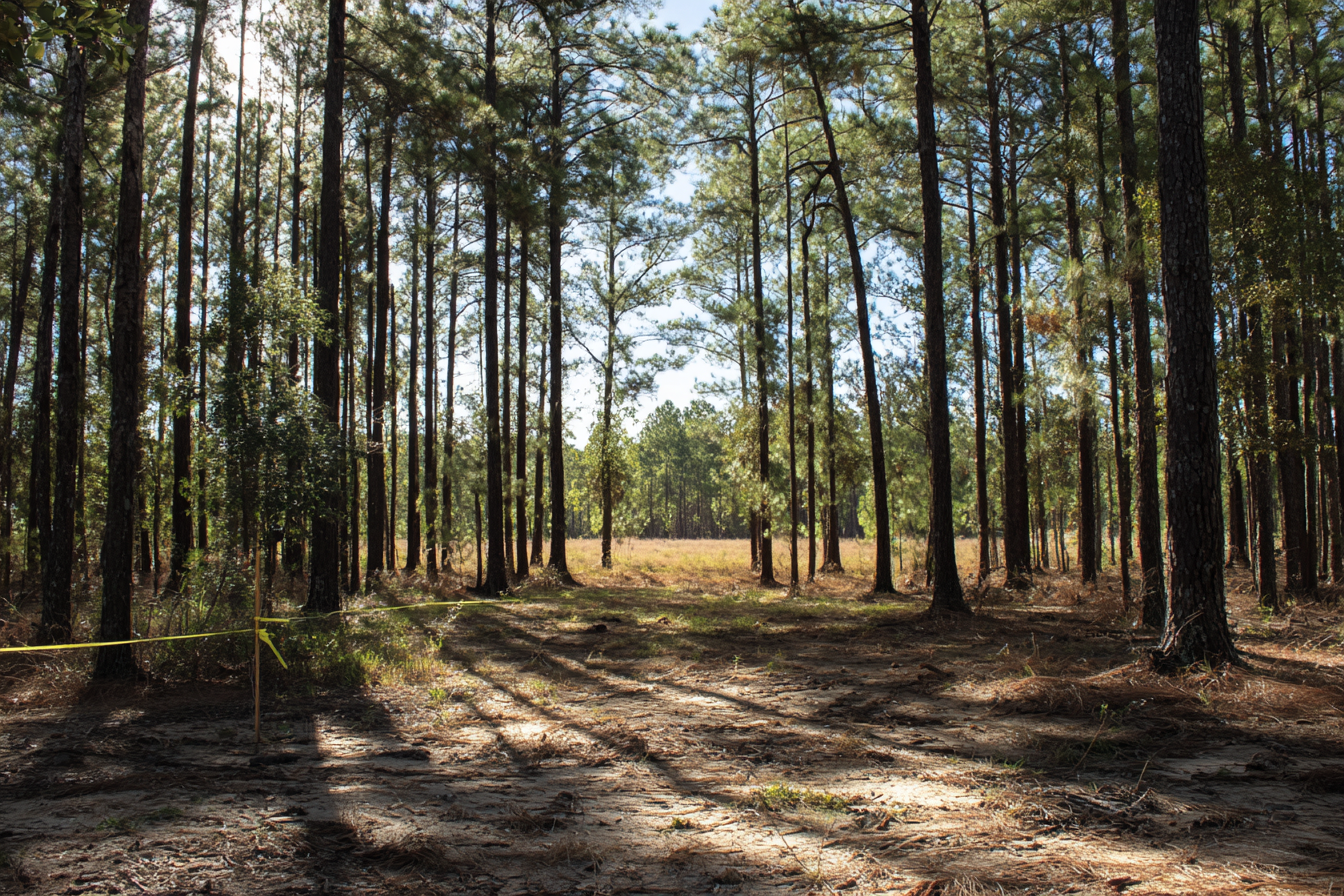
Timber value. Georgia is the number one state in the country for commercial timber production, with 22 million acres of commercially available private timberland — more than any other state. The forest industry contributed $42 billion to the state economy in 2022 and employs over 140,000 people. Many rural parcels include standing timber with significant value, sometimes $5,000 to $20,000 or more on a 20-plus acre tract. A timber cruise (inventory and appraisal), typically costing $500 to $1,500, can reveal value that most land investors completely overlook. This is both a verification step and a genuine value-add opportunity.
Conservation Use Valuation Assessment (CUVA). Georgia's agricultural property tax reduction program is one of the most important verification items for rural parcels. Landowners who enroll property in CUVA receive dramatically reduced tax assessments based on the land's agricultural, forestry, or conservation use rather than its fair market value. The covenant runs for 10 years and renews automatically.
Here's what matters for investors: if you break a CUVA covenant — by developing the land or changing its use — the penalty isn't just repaying the tax savings. It's twice the tax savings realized during the covenant period, plus interest. On a parcel that's been enrolled for several years, that penalty can be substantial. Verify CUVA enrollment status with the county tax assessor before making any acquisition offer. It doesn't necessarily kill a deal, but it must factor into your numbers. This is exactly the kind of hidden cost explored in The True Cost of Skipping Due Diligence.
Coastal regulations. Georgia's coastline is short — roughly 100 miles — but it's heavily regulated under the Coastal Marshlands Protection Act of 1970. This law covers approximately 400,000 acres of salt marsh and requires permits for essentially any construction or alteration in marshland areas. The enforcement extends roughly 55 miles inland in some areas. Parcels anywhere near the coast require additional environmental screening beyond standard FEMA and NWI checks. See our guides on FEMA flood maps and wetlands verification for the baseline process.
Tier 1: High Volume, Strong Margins, Good Data
Barrow County sits in the northeast Atlanta metro growth corridor and has been one of the state's fastest-growing counties. Population jumped from about 70,000 in 2010 to an estimated 96,000–100,000 by 2025 — a 43% increase. The growth pattern is typical of outer-ring suburban counties: residential development pushing outward, land use transitioning from rural to suburban, and rising demand for both smaller residential lots and larger transitional parcels. County GIS data is accessible through qPublic (Schneider Geospatial), the dominant property records platform in Georgia. Verification complexity is moderate — standard environmental screening covers most concerns, and the terrain is manageable rolling Piedmont landscape.
Morgan and Walton Counties are emerging growth plays along the I-20 corridor east of Atlanta, anchored by what may be the most significant industrial development in Georgia in decades. Rivian's $5 billion electric vehicle manufacturing campus is under construction at Stanton Springs North, spanning parts of both counties near Social Circle. The facility secured a $6.57 billion DOE loan in January 2025, with groundbreaking in September 2025 and first production targeted for 2028. At full scale, the plant expects to create 7,500 jobs. The Joint Development Authority managing the site includes Jasper, Morgan, Newton, and Walton Counties. Land values in the surrounding area are already responding to the anticipated economic impact. Morgan County also offers good positioning between Atlanta and Macon along the I-20 corridor, with timber parcels available and moderate competition.
Jackson County sits along the I-85 corridor northeast of Atlanta and benefits from the broader northeast Georgia growth trend. The county has strong demand driven by its positioning between Athens and the outer Atlanta suburbs, with affordable entry relative to closer-in counties like Gwinnett and Hall. Transaction volume is steady, and the county's GIS data is accessible through standard Georgia platforms.
Tier 2: Solid Opportunities With Known Challenges
Paulding County is part of the west Atlanta growth corridor, with strong residential demand pushing outward from Douglas and Cobb Counties. The challenge is that the market is maturing — entry costs are rising, competition from local investors and builders is increasing, and the easiest margins have compressed. Still viable, but you need to be sharper on your comps and faster on your offers than you would have been three years ago.
Chatham County (Savannah metro) offers coastal demand, a well-known historic city attracting both tourism and permanent relocation, and good county data infrastructure. The challenge is environmental — flood zone and wetlands exposure is significant in a coastal Georgia county.
Every parcel needs thorough screening, and you should expect a higher disqualification rate than in inland counties.
Lowndes County (Valdosta area) sits in southern Georgia and benefits from a military buyer base — Moody Air Force Base, home to approximately 5,500 active duty personnel, is an active installation near Valdosta currently transitioning from A-10C Thunderbolts to F-35s. The buyer pool is real but thinner than what you'd find near Atlanta, and the distance from major metros means longer hold times on retail dispositions.
Hall County (Gainesville / Lake Lanier area) combines strong recreational demand with proximity to the northeast Atlanta growth corridor. The Lake Lanier waterfront drives premium pricing on certain parcels, and the outdoor lifestyle appeal is genuine. Challenges include higher entry costs, significant topographic variability (foothills terrain), and competition for the best parcels from both investors and end-user buyers.
Tier 3: Emerging and Niche Opportunities
Georgia's secondary growth corridors hold longer-term potential. The I-16 corridor between Macon and Savannah, and the I-20 corridor between Atlanta and Augusta, both show early signs of the growth-spillover pattern that's already played out closer to the metros.
South Georgia agricultural counties — the timber belt — offer a different play entirely. Timber and farmland values create a floor beneath vacant land pricing, and the income from standing timber can offset holding costs. This is a patience play, not a flip play, and it requires understanding timber markets in addition to land markets.
The north Georgia Blue Ridge mountain counties have a small but growing recreational and retirement market, driven by the same remote-work migration patterns reshaping western North Carolina. Volumes are low, but demand is steady for the right parcels.
Georgia Verification Essentials
For a comprehensive checklist that covers every state, see our land due diligence checklist. Below are Georgia-specific items that demand extra attention.
Transfer taxes. Contrary to what you might read elsewhere, Georgia has both a real estate transfer tax and a separate intangible recording tax. The transfer tax runs approximately $1 per $1,000 of sale price. The intangible recording tax applies to mortgage notes at $1.50 per $500 of face amount, capped at $25,000. These are distinct taxes — the transfer tax hits the deed, the intangible tax hits the security instrument. Rates are relatively low compared to many states, but they exist and should factor into your cost analysis.
Georgia's recording system. Georgia uses a deed recording system, not Torrens. Chain of title verification is important, particularly for parcels that may have changed hands informally in rural areas. Watch for tax sale properties — Georgia tax sales carry a 12-month right of redemption, during which the former owner can reclaim the property by paying the sale price plus a 20% premium. Don't plan to develop or resell a tax-sale parcel until the redemption period has expired.
Septic and well considerations. Rural Georgia parcels rely on septic and well systems, with county environmental health departments managing the permitting. The Piedmont region's heavy red clay soils create specific challenges for conventional septic installations — poor drainage, high failure rates, and frequent need for alternative engineered systems that cost significantly more. If you're evaluating parcels in the Piedmont (roughly the middle third of the state), treat soil suitability as a go/no-go factor, not a nice-to-know.
Wetlands in the coastal plain. Southern and coastal Georgia have significant wetlands presence, particularly along river corridors and in the coastal zone. NWI data quality in Georgia is mixed — better in coastal counties due to federal mapping priority, weaker in inland rural areas. If a parcel is anywhere near water features in southern Georgia, budget for thorough wetlands screening.
Data Quality Across Georgia Counties
Georgia benefits from the qPublic.net system, operated by Schneider Geospatial. This statewide platform is used by the majority of Georgia's 159 counties for property records, tax data, and GIS access. Data quality varies by county, but the consistent platform means you're not learning a new interface for each jurisdiction.
Metro Atlanta counties (Fulton, Gwinnett, DeKalb, Cobb) have excellent data infrastructure but are generally not target markets for land investors due to high entry costs and intense competition. The sweet spot is the outer-ring counties where growth is active but data systems are still reasonable.
State-level resources supplement county data effectively. The Georgia GIS Clearinghouse (with portals at data.georgiaspatial.org and the newer GIO Data Hub) provides statewide spatial data. Georgia EPD (Environmental Protection Division) maintains water quality, hazardous site, and contamination databases at epd.georgia.gov. And the Georgia Forestry Commission provides timber market data and resources that are particularly relevant for rural parcels.
Rural county data quality is generally better in Georgia than in comparable rural counties in other southeastern states, thanks largely to qPublic's statewide reach. But "better" doesn't mean "complete" — expect to make phone calls to smaller county assessors for information that isn't in the online system.
For a comparison of how manual versus automated verification handles the variability across Georgia's 159 counties, see our dedicated analysis.