What Is a CDD Fee? Florida Land Buyer's Guide
A yearly assessment on the Florida tax bill. How to check a lot, what it costs, whether it ends, and how to price it.
A CDD fee is a yearly charge from a Community Development District, a special-purpose local government that Florida law lets developers create to build and maintain roads, drainage and similar infrastructure. The charge is a lien on the lot and shows up on the property tax bill as a non-ad valorem assessment, on top of your regular county taxes (Fla. Stat. 190.021).
CDD fees vary by 10x or more from one district to the next. On the tax bills we've pulled, they run from about $135 to about $3,000 a year.
Quick check before you buy
- 1.Find the parcel on the county property appraiser's site and write down the parcel or account number.
- 2.Open the tax bill and read the non-ad valorem section. A line with "CDD" or "Community Development District" in its name answers the question.
- 3.Note the dollar amount, then split it into bond debt and operations and maintenance.
- 4.Find the district's website and read the current budget and assessment schedule.
- 5.Ask the district manager for a payoff or prepayment figure, if the bond documents allow one.
- 6.Price the lot for the buyers left once they add the yearly charge to their monthly cost.
Check it yourself, step by step
We'll use Brevard County. The same path works in any Florida county, since every county has a property appraiser and a tax collector. Screen layouts change, so expect the buttons to move.
Step 1. Look up the parcel on the property appraiser site. Brevard's is bcpao.us. Search by address, owner name or parcel ID. Vacant land often has no street address, so use the parcel ID from the seller's paperwork or the county GIS map. Write down both the parcel number and the tax account number. They can differ.
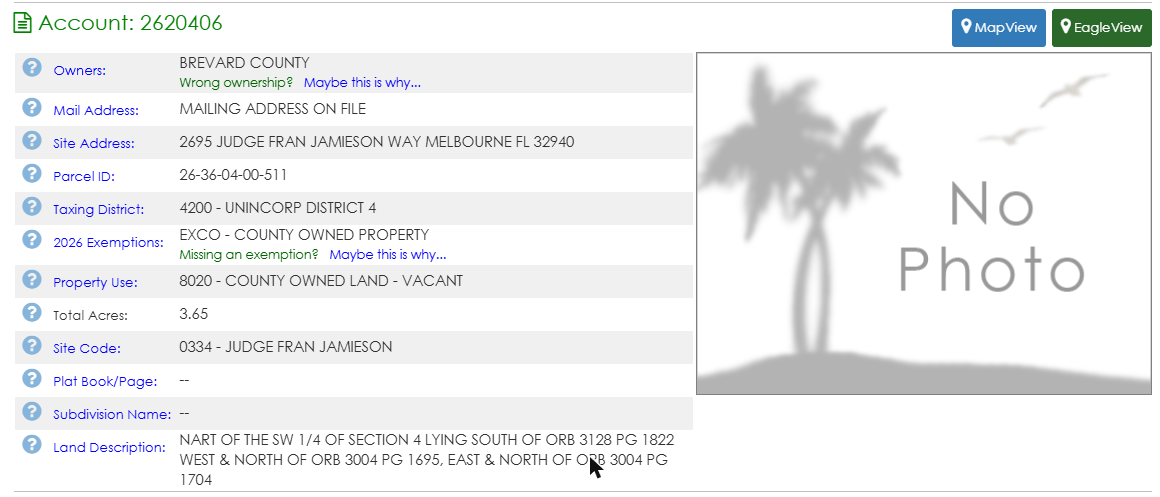
Brevard County Property Appraiser (bcpao.us), parcel record for a vacant county-owned lot (October 2026). Mailing address hidden.
Step 2. Open the tax bill on the tax collector site. Brevard posts its bills at county-taxes.net/brevard. Search by account number, pull up the current year and scroll to the non-ad valorem section. You'll see one line per levy.
A local government can ask the tax collector to put its non-ad valorem assessments on the combined tax notice (Fla. Stat. 197.3632), and a CDD may collect this way (Fla. Stat. 190.011). Some districts bill owners directly instead. A clean tax bill is a good sign, and you still confirm it in Step 4.
Step 3. Separate the CDD from the county charges. The bills we pulled also carried fire, solid waste and stormwater lines. The county levies those. The CDD line carries the district's name.
Step 4. Find the district's website. Florida requires every special district to keep an official website that posts its budget and the assessments and fees it imposes (Fla. Stat. 189.069). Search the district name from the tax bill plus "CDD". Pull the adopted budget, the assessment roll and the audit.
Step 5. Split the charge in two. The budget lists a debt service assessment, which repays the bonds, and an operations and maintenance assessment, which pays for upkeep, management and insurance. The audit or the bond documents give the payoff schedule, which tells you how many years of debt service remain.
Step 6. Call the district manager. You'll find the contact on the district website. Ask for the remaining bond balance on the lot and whether the district allows prepayment. Get the answer in writing.
Step 7. Save everything with the date. A buyer will ask, and you'll want the bill, the budget and the email ready.
CDD fees in Florida: what they pay for
A CDD issues bonds to build its roads and drainage, then repays them with special assessments on the lots it serves. It levies a second assessment each year to maintain what it built (Fla. Stat. 190.021).
The district's board sets both amounts and adopts a budget before October 1 after a public hearing (Fla. Stat. 190.008). The O&M amount can rise or fall from year to year, so read this year's budget.
Lenders and title companies care about the lien. The statute ranks the assessment lien equal with state, county, municipal and school board tax liens (Fla. Stat. 190.021). When the tax collector bills it, the county treats nonpayment like unpaid property tax, tax certificates included (Fla. Stat. 197.3632). If you hold a lot and skip the CDD line, you face the same path as skipping the county tax.
What are CDD fees in Florida worth to a buyer?
Your buyer pays the charge every year, whether they build or not, and the amount swings by 10x or more between districts. Two lots a few miles apart can carry $135 and $3,000 a year.
At $135, the charge barely touches a buyer's math. At $3,000, it adds $250 a month before taxes and insurance. That spread is why you read the bill for every lot instead of assuming a typical figure.
A hypothetical: two similar lots list for $60,000. One sits outside any district. The other carries $2,400 a year. A buyer planning a 10-year hold sees about $24,000 in CDD charges on the second lot, before any budget changes. They may still prefer it, because the district built the roads and drainage the first lot lacks, but they won't pay the same price. Run the real bill and budget for your lot.
Florida requires a boldface disclosure of the district's power to levy taxes and assessments in the contract for the initial sale of a parcel or unit inside a CDD (Fla. Stat. 190.048). That rule covers the developer's first sale. On a resale, nobody has to hand you that notice, so you do the checking.
Do CDD fees ever go away?
The bond part can. The upkeep part stays.
The bond (debt service) part. The statute ties this assessment to the bonds and makes it a lien on the property "until paid" (Fla. Stat. 190.021). The district sets each annual installment to repay the bonds, so it runs as long as they do. The statute sets no end date for any one district. Find the payoff schedule in the district's audit or bond documents.
The O&M part. As long as the district exists and owns roads, ponds and landscaping, the board will levy an O&M assessment each year. A bond payoff lowers the bill and leaves this part in place.
Ask the district how many years of debt service remain, and plan on the O&M amount continuing.
How to get out of CDD fees
A lien already on the lot stays with the lot. Your options:
- Pay down the bond portion early. Some districts let owners prepay the bond assessment, often at the principal balance plus accrued interest. The district's assessment resolution and bond documents decide it. Ask the district manager for the figure in writing.
- Wait for the bonds to retire. If the debt service ends in a few years, holding may cost less than a payoff.
- Pass on the lot. A large charge with decades of bonds left is a reason to buy outside the district.
- Talk to a Florida real estate attorney about contesting an assessment or changing a district. That's a legal project with its own costs.
If a seller or agent says "the CDD comes off at closing," ask for the district's written payoff letter.
Full price, discount or pass
- No CDD on the bill and no district in the area: full price.
- A few hundred dollars a year, bonds nearly paid: small discount, or none if your comps carry the same charge.
- A mid-range charge with years of bonds left: discount by the buyer's total cost over a realistic hold, and compare against lots that sold inside the same district. See How to Comp Vacant Land.
- A large charge, long-dated bonds, and no roads or utilities in yet: pass, or price it so far under market that the buyer still wins.
- No budget or payoff figure available: we'd pass until you get one.
Who to call
- Property appraiser (Brevard: bcpao.us): parcel identity and legal description.
- Tax collector: the tax bill, the non-ad valorem lines and any delinquency.
- District manager: the budget, the bond balance and the prepayment rules.
- Title company: unpaid assessments, lien position and what shows at closing.
- Florida real estate attorney: dissolving a district or contesting an assessment.
CDDs sit beside other recorded burdens. For deed restrictions and association dues, read How to Detect HOA and Deed Restrictions. For the full list of checks, see The Complete Land Due Diligence Checklist. Shopping Florida counties? Start with Best Counties for Land Investing in Florida, and see The 5 Most Common Reasons Land Deals Fall Through at Closing for where a surprise charge fits.
Screening a list of Florida lots by hand means a tax bill and a district website for every parcel.